
Custom theatre shielding delivers fourfold reduction in radiation exposure during intraoperative PET-CT
9th September 2026
At a glance
> A recent study conducted at University Hospitals Coventry and Warwickshire NHS Trust has evaluated the radiation safety requirements for the UK's first mobile specimen PET-CT imager for surgical oncology.
> As part of the trial, BriTec designed and manufactured bespoke shielded equipment to address the practical challenges of managing radioactive materials within theatre.
> Over a 10-month period, researchers evaluated 56 surgical procedures and found radiation doses remained well controlled across all staff groups, with contamination events being rare, minor and effectively managed.
Supporting the eXcision trial's investigation into surgical orncology
A recent study conducted at University Hospitals Coventry and Warwickshire (UHCW) NHS Trust evaluated the radiation safety requirements necessary for the UK's first deployment of a mobile specimen PET-CT imager for surgical oncology. This allows surgeons to assess excised tissue immediately after resection with the patient still in theatre. Findings demonstrated that intraoperative PET-CT can be introduced safely when supported by appropriate radiation protection measures, specialist shielding and carefully considered working procedures.
As part of the eXcision trial conducted by UHCW, BriTec designed and manufactured bespoke shielded equipment to address the practical challenges of managing radioactive materials within theatre. These formed part of a wider safety strategy that enabled the implementation of new technology.
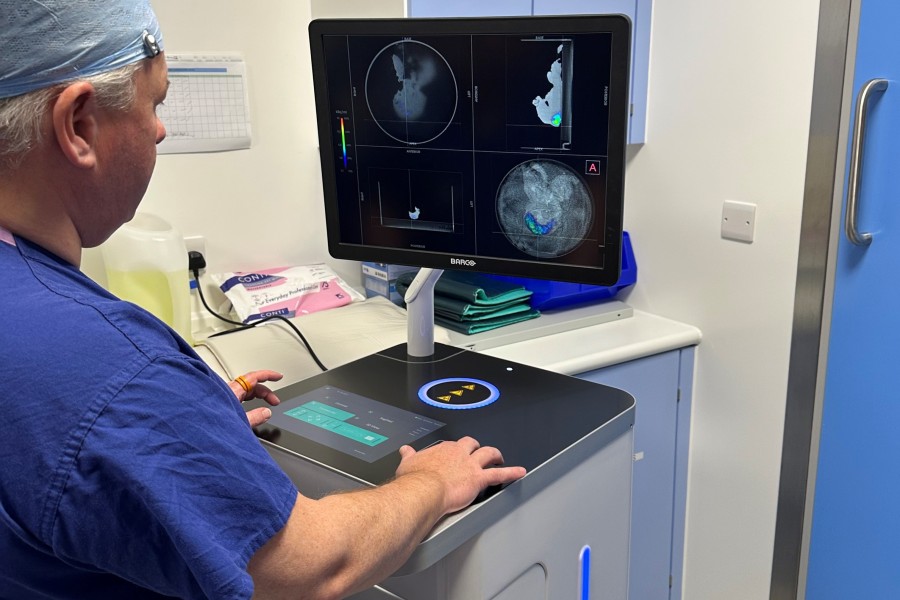
Intraoperative PET-CT enables surgeons to assess margins immediately after tissue resection.
Measurable reductions in staff radiation exposure
To manage radioactive waste generated during head and neck procedures, BriTec designed a stainless-steel catheter bag trolley incorporating 6 mm lead shielding. This allowed the catheter bag to be safely housed during surgery while reducing radiation exposure to theatre staff.
The thickness of the shielding was chosen because 6 mm of lead represents approximately one half-value layer for 511 keV photons, allowing the trolley to provide effective radiation protection while still being light enough to manoeuvre and position safely within the operating theatre.
Most significantly, the study demonstrated a measurable reduction in occupational exposure. Dose rate measurements recorded on the catheter bag trolley showed an average fourfold reduction compared with measurements taken directly on the catheter bag itself. The average unshielded dose rate measured on the catheter bag surface was 11 µSv/h, with values ranging from 1.2 µSv/h to 48 µSv/h.
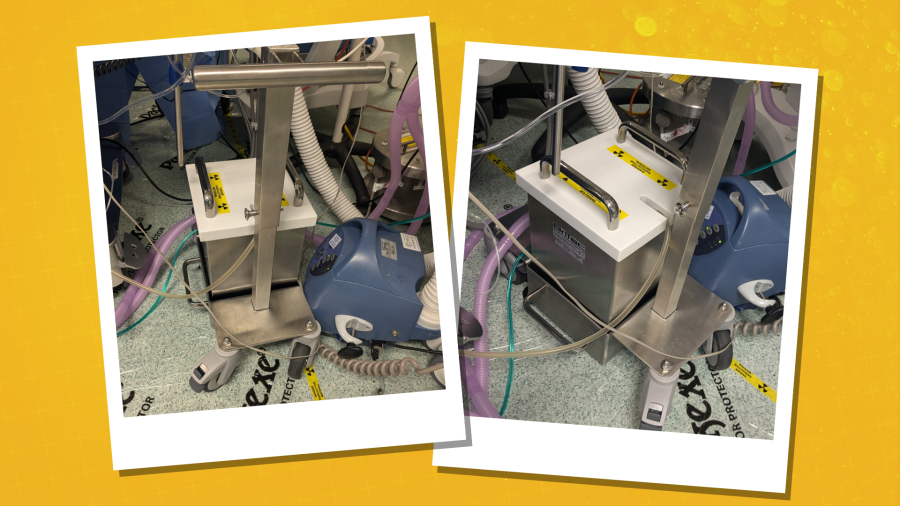
Catheter bag trolley designed and manufactured by BriTec (images published with permission by UHCW).
Safe containment and management of radioactive materials in theatre
BriTec also designed and manufactured a specialist shielded equipment trolley to support the safe storage and containment of radioactive materials generated during surgery. The trolley incorporated 6 mm lead shielding and provided dedicated storage for sharps bins, radioactive swabs and contaminated surgical items. A radiation spill kit was stored on the lower shelf for contingency, while the upper shelf was built as a monitoring station for routine radiation and contamination checks.
How effective was the radiation monitoring?
Over a 10-month period, researchers evaluated 56 surgical procedures, including 18 head and neck cases and 38 urology procedures. Radiation doses remained well controlled across all staff groups, with the highest exposures recorded among personnel working closest to patients. Average whole-body doses for head and neck procedures were measured at 39 µSv for surgeons and 12 µSv for scrub nurses, while corresponding doses in urology procedures were 7.2 µSv and 2.5 µSv respectively. Staff working outside the theatre environment, including recovery and histopathology teams, received negligible or below-threshold doses.
Contamination events were rare, minor and effectively managed through established monitoring and decontamination procedures. Notably, no skin contamination incidents were recorded during the study, demonstrating the effectiveness of the monitoring and protective measures implemented.
Find out more
You can learn more about BriTec’s tailored solutions by the clicking the button below to speak to a product specialist directly.